
Kate Pattison, RMIT UniversityWith Taylor Swift pulling in over half-a-million audience members on her Australian tour, we’ve been thinking a lot about fans. In this series, our academics dive into fan cultures: how they developed, how they operate, and how they shape the world today. Fans and the internet have a symbiotic relationship. The digital era increased the productivity and visibility of fan culture, which in turn has largely influenced the ways that we all act online. Fan communities existed long before the internet, but the proliferation of online platforms changed the ways in which they connect and participate. Here is a brief history of how fan cultures shaped – and were shaped by – the internet. Early adoptersAs early as the 1970s, fans were participating in digital spaces. Some of the first email mailing lists and digital bulletin boards were utilised by Grateful Dead fans, or Deadheads, who came together to create an online archive of lyrics. In the 1990s, science-fiction fans established online repositories, using Usenet groups for fannish discussion and fan-fiction distribution. As the adoption of the internet became more widespread, so did fan culture. You could simply search for your favourite TV show or band and find a like-minded community online. This brought on an era of forums and blogs, where fans were quick to jump on sites like LiveJournal to write and build communities. As social media platforms launched in the 2000s, fans co-opted them for their fan practices. MySpace fans helped launch many music careers; One Direction fans put Tumblr on the map. When Twitter took off, so too did “Stan Twitter”. As a verb, to stan is to exhibit fandom to an excessive degree. The public nature of Twitter (now X) allowed fans to come together in large groups to start trends and campaign. This collective power has been both praised for digital activism efforts, and criticised for harassment. The public and the privateFans move between private and public spaces online, negotiating different identities. On platforms like Tumblr and LiveJournal, fans often choose a pseudonym, whereas Facebook enforces a real-name policy. Different platforms offer different privacy settings, which also shapes fan behaviours. Private spaces allow for personal conversations, while fans embrace public channels for sharing fan works and campaigning, for example, for voting or fundraising. Each platform has different social norms and functionality. Fans adapt and develop their fan practices accordingly. In doing so, they have shaped the social internet as we know it today. Fan migrationsThe launch of a new platform introduces new ways to participate. Tumblr became the place for “"fuckyeah” fansites, sharing fan works and communicating via GIFs. Fans jumped on TikTok to create video edits, sounds and mashups. Fans may also choose to leave a platform because it no longer satisfies their needs or the platform goes through significant changes, as when Tumblr announced a ban on adult content, or when Elon Musk bought Twitter. While the launch of Meta’s Threads provided a possible replacement for stan participation, some fans were hesitant to migrate across. Users must log in to Threads via their Instagram account, a platform many use to stay connected with friends and family. On Twitter/X, fans expressed they were weary of the new platform, because they did not want their fan activities to be connected to their “real life”. In cases where existing platforms haven’t met the community’s needs, fans have created their own. Archive Of Our Own (AO3) is a repository for fans to share works inspired by the objects of their fandom, created in response to design and policy changes made on other fan-fiction sites. TransformationsFans are known for their creative productivity, transforming and remixing their favourite cultural objects in fan-art, fan-fiction, videos, zines and music remixes. Technological advancements made creative production easier to master, and the public and networked nature of platforms has allowed fan works to be circulated to a much wider audience. Audio from fan-edits often become trending TikTok sounds. How fans shape brandsThe mainstreaming of fandom across digital platforms has also led to changes in brand behaviour. Some brands have started to act like fans online, learning from fans’ behaviours to form an affiliation with these engaged audiences. On TikTok, brands are participating in fan-based trends, tapping into community-specific knowledge and jokes. The Empire State Building has leaned into #swifttok, regularly creating content that demonstrates their love of Taylor. One of their most successful videos is a fan-edit professing their love for the Eiffel Tower, set to a sped-up version of Wildest Dreams. Brands are also adopting fan language and tone in their captions and comments. Take a look at the comments on one of Taylor Swift’s recent TikToks and you’ll find brands like DuoLingo, Spotify, The Natural History Museum and Peter’s Pasta using words like “blondie”, “mother” and “ICON”. On Twitter/X, cookie brand Chips Ahoy! regularly posts about trending fan-culture moments, demonstrating insider knowledge. On Threads, the official Star Wars account is stanning favourite characters, adopting a fannish persona. And on TikTok, Penguin Books Australia is “shipping” Draco and Hermione to promote Tom Felton’s new book. In my ongoing PhD research, I’ve found fans are working as social media managers for brands, leveraging their expertise to connect with fan audiences. Given the widespread adoption of fan culture and practices across platforms, it makes sense that a fan’s digital literacy can be beneficial to brands. As one Harry Styles fan that I interviewed explained:
Kate Pattison, PhD Candidate in Music Industry, RMIT University This article is republished from The Conversation under a Creative Commons license. Read the original article. |


Digital humans make their mark in real life (2023-04-20T17:21:00+05:30)
 Virtual stars in demand for TV shows and online platforms Lu Ping/China Daily: Virtual stars proved a resounding success at numerous New Year celebration galas hosted by television stations and video platforms to attract young audiences. Designed to increase human interaction, these digital avatars are created by technology powered by artificial intelligence. At the New Year's Eve gala staged by Bilibili, a short-video sharing platform popular with young people, celebrity virtual idol Luo Tianyi performed five songs in 10 minutes and appeared alongside real-life dancers to celebrate the 10th anniversary of her debut. The show attracted more than 1.4 billion views. A virtual anchor created by Dragon TV played a flute and danced with celebrity singer Cheng Xiao during the Shanghai broadcaster's New Year gala, which was watched by tens of millions of viewers. A virtual rock band caught the eye at a concert staged by Sichuan Television to mark the arrival of 2023. The band comprises five digital avatars based on cultural relics found at the Sanxingdui site in Deyang, Sichuan province, which is known for its exotic-looking bronze statues. Ma Yuqi, joint director of the concert, said the band's appearance was designed to attract as many young audience members as possible. The appearance of virtual beings at New Year galas staged by TV stations and online platforms reflects just how popular these figures have become in China in the past 12 months. The concept of the metaverse — where the physical world combines with the virtual — has also gained traction in recent years. According to a report on the virtual people industry last year released by the consultancy company iiMedia Research in April, the estimated market scale of virtual humans was some 12.08 billion yuan ($176 million) and will reach about 20.52 billion yuan this year. The report said digital beings are now used widely in the entertainment and cultural sectors as icons, anchors and employees. In China, this boom is largely driven by Generation Z — those born in the late 1990s or early 2000s, who are seen as being familiar with digital technology, the internet, and social media from a young age. Ji Zhihui, who has observed the industry for more than a decade, said Generation Z members matured as the Chinese economy and technology developed rapidly. As a result, this group has taken to online activities such as watching videos, listening to music, and making friends. Generation Z comprises the majority of the metaverse's future residents, Ji said. "In the future, internet users will migrate to the virtual world," Ji added. Wider audience One of China's leading streaming platforms, iQiyi, was among the first companies to invest in virtual beings. Two years ago, it launched a virtual idol talent show, Dimension Nova, aimed at introducing such idols to a wider audience. The show generated popular hashtags that were viewed more than 1.2 billion times in two months on the Sina Weibo micro-blogging platform. On New Year's Eve, iQiyi staged Retaland, a virtual concert in four parts based on various themes. The performers were all virtual idols, and one of them was created from the image of popular star Gong Jun, known for his role in a martial arts TV series. According to iQiyi, the concert was aimed mainly at Generation Z. Lu Bin, head of a virtual idol studio affiliated with iQiyi, said: "Followers of these idols are mostly young people who grow up with anime, comics and games. Those younger than 24 account for the majority of this group." The studio, which was set up in 2021, has signed more than a dozen digital beings, including band members, anchors and influencers. One of the studio's star performers, D.M, features twin siblings Damian and Millie. The former is a handsome rapper, while the latter is a cool street dancer. They have their own accounts on numerous social media platforms, and perform at concerts and art shows. A-Soul, a virtual girl group created by Yue Hua Entertainment, a leading celebrity agent in China, comprises five members, each of whom has a distinctive style. Members of the group have millions of followers on social media platforms, and they have been in high demand on Bilibili, a short-video sharing platform especially popular with Generation Z. In 2019, Bilibili launched a section for virtual influencers, including anchors and idols. Chen Rui, the company's CEO, said at a meeting in November that the platform is home to the most virtual influencers worldwide. More than 230,000 virtual anchors broadcast music, dance and game videos to audiences mainly in the 18 to 35 age group. The air time of virtual influencers on the platform last year surged by 200 percent year-on-year. Luo Tianyi, a virtual singer who debuted 10 years ago, is the most popular such celebrity on Bilibili. Luo's fans compose music, write songs and draw illustrations for her — contributing greatly to developing the digital avatar's personality. At a cultural event to celebrate the Beijing Winter Olympics in February, Luo sang the song Time to Shine while wearing a light blue qipao, which gave her exposure to a wider audience. According to media reports, some 30 virtual celebrities took part in activities related to the Winter Olympics in the Chinese capital, including a digital avatar of champion freestyle skier Gu Ailing. Unlike Luo, whose image is largely based on animation, many of her counterparts look like real people. For example, Tianyu, modeled on the Flying Apsaras, a motif on murals at the Mogao Caves in Dunhuang, Gansu province, has won more than 3.5 million followers since debuting in April last year on the short-video platform Douyin. Many netizens said they could not tell whether Tianyu was a real person or not. A clip of Tianyu on Douyin lasting less than two minutes garnered nearly 2 million likes. In the footage, she helps a popular TV actress fight a bad guy. Tianyu's stunning beauty and stylish clothes are inspired by elements of traditional Chinese culture. The virtual star can play the pipa (a four-stringed instrument) and perform jin dance (a unique dance style in ancient China). Zheng Yicheng, who manages the studio in which Tianyu was created, described the virtual being as "the beacon to spread Chinese culture to the world". Tianyu has received many invitations to film advertisements for brands, including one in which she collaborates with an electric car company. Zheng said a number of cities have also invited Tianyu to act as an ambassador to help promote culture and tourism. Policy support The boom in virtual avatars has been accompanied by policy support from the central and local governments. In October 2021, the National Radio and Television Administration announced a plan to promote the wider application of virtual anchors and animated presenters in news broadcasts, weather forecasts, variety shows, and science and education programs. As a result, numerous media outlets have hired digital employees as reporters, hosts and anchors. Many of these employees have reported on major events. In May last year, the State Council introduced a regulation to encourage the use of digital technologies to promote Chinese culture. Three months later, Beijing announced a detailed plan to transform its virtual people industry into a market worth more than 50 billion yuan by 2025. The plan encourages the use of virtual people in variety shows, concerts, livestreaming and film productions. It is the first city-level plan to focus on this emerging industry. In October, the report to the 20th National Congress of the Communist Party of China called for "a national cultural digitalization strategy", viewed by many observers as a catalyst to the booming virtual beings industry. Cultural organizations, art institutions and cities were quick to create their own digital ambassadors or virtual spokespeople. Last year, the China National Museum welcomed its first digital employee, Ai Wenwen, who works in different departments at the institution to learn about art collections, art displays and the research of cultural relics to prepare for museum-related work in cyberspace. In June, the Ninth Qin Opera Art Festival in Xi'an, Shaanxi province, launched a virtual spokeswoman who can sing Qinqiang Opera. This art form, which originated in the Western Zhou Dynasty (c. 11th century-771 BC), continues to thrive in a vast area of Northwest China. In 2006, it was added to the nation's intangible cultural heritage list. Chen Shaofeng, a professor of cultural industries research at Peking University, said the mushrooming growth of digital humans in the cultural industry is an inevitable trend that will provide a good and innovative service for the public."With highly developed technologies, the cultural sector will largely embrace the virtual world. It's a challenge for us all. We should think about how to work with these virtual beings to offer a better service," Chen added. Source: China.org.cn |
Nicole Kidman, face of airline campaign (2016-05-01T23:14:00+05:30)
 |
Meet new breed of digital age: Generation Z (2016-05-01T01:27:00+05:30)

Facebook? Of course. Books? Definitely not. Video games? For sure. Sport? No way. Speed? Yes. Patience? Not so much. This, in a nutshell, is the life of the “Generation Z” — independent, stubborn, pragmatic and always in a rush. Numbering around two billion, these youngsters, born after 1995 and unaware of a world without Internet, live a life that seems a million miles removed from the hopes, dreams and morals of previous generations. Here are a few of the habits of Generation Z: Daily life: They want everything, everywhere and immediately. They surf on two screens simultaneously. They don’t mind paying through the nose for the latest smartphone but turn up their nose at paying for a film or a song when you can get that for free online. Aged 13 to 20, they get all the latest trends from social media and find the morals of their elders out-of-date. Their fashions are those found worldwide over the web: they watch American blockbusters like Hunger Games or Divergent, listen to Korean K-pop and, when they dance, they “twerk”. When they speak, their vocabulary is peppered with acronyms, incomprehensible to those not in the know. “Swag” is the new “cool”. Their friends: People from Generation Z find it easier to talk online than in person. Their friends on social media are as important to them as their friends in real life but sometimes they do actually meet up in person with these “virtual” pals. What they know: Even as young as they are, they have already seen so many technologies become obsolete. For this reason, they have become the ultimate “self-educators”, learning how to use new stuff via self-help videos on YouTube. What they watch: They live in constant “FOMO”, fear of missing out. They can’t stand the idea of not being in the loop when something new and exciting comes out. Facebook is their main poison, despite its flagging popularity among some Americans. Photos on Instagram, quick messages on Snapchat. Twitter and Tumblr are omnipresent. At work: They believe success comes from their “network” rather than from qualifications and they prefer a flat organisation to a hierarchy at work. The future of Generation Z: These are children of the crisis and it shows in their outlook. Most of them say they are “stressed out” by what they see as a bleak future, especially in terms of economy and environment. Given the same pay, 25 per cent of the Generation Z in France would choose the most “fun” company, 22 per cent the most innovative and 21 per cent the most ethical. But like any idealistic generation, they want to change the world. Source: Articlee, Reference-Image
|
The Internet is losing its baby teeth (2016-03-18T01:26:00+05:30)

In 2010, Chris Anderson, editor of Wired magazine, wrote “The Web Is Dead.” He argued that the future of the Internet and connectivity wasn’t in the World Wide Web, but in a fragmented collection of many different platforms — people consuming content via mobile devices, native apps and other means outside of a traditional web browser. While Anderson’s sensational claim raised a lot of eyebrows, and sparked enormous debate, I wasn’t sure what to make of his prediction at the time. But four years later, we have a little more perspective. In 2014, ‘the web’ — the means by which we access the Internet using a web browser — is hardly dead, although there certainly has been a significant shift our relationship with the Internet. In its infant stages, going online meant using AOL or Earthlinkto dial up a connection to the web. Today, we use the Internet for different reasons, and our connectivity is better, faster and stronger than ever. The disruptive technology that is the Internet is no longer a baby, it’s more like a toddler learning to walk. When your babies learn to walk, you breathe a sigh of relief at their newfound mobility. But that relief quickly turns to frustration as you realize you’ve only traded one set of problems for another. Your newly mobile child can now get into everything, climb and break everything. The same is true with the Internet. One of the most astonishing ways it's changed our lives, for example, is by changing the way we consume music and videos. It’s severed our ties to old, “hard media” like videotapes, CDs and DVDs — an amazing liberation — but has also introduced a whole new, frustrating labyrinth of alternatives at the same time. Anderson’s prediction of fragmentation is most obvious when you look on top of (or under) your TV. Odds are, where we used to store our DVD cases and video sleeves, most of us now have an assortment of streaming devices. Instead of having one giant VCR, we can now choose from having a cable box, TiVO, DVR, Apple TV, Chromecast, Roku, Amazon Fire TV and much more. But the irony is that with all these choices, we can’t actually choose just one. You can’t stream iTunes media through your Chromecast, and you can’t watch Amazon Prime on your Apple TV. Roku is great, but doesn't work with AirPlay. You can watch Netflix on your Apple TV, but, of course, Netflix doesn’t have half the movies you wish it did available for streaming. If you want voice control on your device, only Amazon Fire TV has it. Are you the old fashioned type who still likes using a remote control? Don’t get Chromecast. Oh and by the way, if you don't want a wallet-sized device cluttering up your living room, you can just switch to Amazon’s new Fire TV Stick, which is about the size of a thumb drive. But that’s only if you don’t already have the Roku Streaming Stick, or if you aren’t waiting for Wal-Mart’s just-announced VUDU Spark Stick. (I can’t wait to see what Microsoft and Blackberry have up their sleeves to try to jump into this game — their product names are bound to be interesting.) I’m old enough to remember watching VHS tapes, but not enough to remember the video format wars in the ‘80s. My dad told me a story of the VHS tape fighting against the smaller, arguably better, Betamax format. As the story goes, VHS ended up with a better selection of videos – today we’d say they had more “content providers” — and ergo won the format war despite downfalls in size and picture quality. There was a similar war in the early 2000s: HD-DVD vs. Blu-Ray. But what this costly war actually proved was that hardware format doesn’t matter anymore. While people were busy upgrading their home video collections from VHS to HD-DVD or Blu-Ray, the Internet was born. Streaming digital media became the new way to watch movies and most of us stopped purchasing movies altogether, opting for monthly subscription fees for on-demand consumption using services like Netflix. The lure of the Internet delivering whatever we wanted, whenever and wherever we wanted and on any device wanted, trumped everything else. Is this all for the better? I still don’t know. I see benefit in no longer needing to spend my hard-earned cash on hardware that’ll become obsolete in five or 10 years, and not being confined to a desktop when I want to access web content. (I'm grateful to be free from lugging my massive CD sleeve around in my car too. However, there’s always the risk that I’ll want to listen to a certain album, or watch a certain movie, only to find out that it's “not available.”) I think we’ve reached an awkward phase for the Internet. It’s beyond the baby stages and learned to walk. It’s still gaining confidence, and smiles a big, toothy grin with several missing teeth. The web isn’t dead; we’re all just impatiently watching it to grow up. Ron is a web guy, IT guy, and Internet marketer living in Colorado Springs with his wife and five children. He can often be overheard saying things like "Get a Mac!" and "Data wins arguments,” wandering around the downtown area at least five days a week. Follow him on Twitter at@ronstauffer or email him at indy@ronstauffer.com. Questions, comments and snide remarks are always welcome. Source: Article, Image: https://flickr.com
|
NEC launches digital cinema laser projector (2015-12-16T19:36:00+05:30)
NEC Display Solutions Europe has launched a digital cinema laser projector called the NC1202L, which is suitable for use in boothless cinema installs.
The NC1201L features NEC’s sealing technology, which has a sealed optical engine and laser engine with circulating air cooling, which reduces maintenance requirements by minimising the opportunity for dust and smoke to enter the optical block. An Integrated Media Server (IMS) is included as standard, it has a 2TB net capacity, fast upload of movies via USB 3.0 or Gigabit Ethernet, possible during playback, and support for playing movies directly from Network Attached Storage (NAS). The laser has a typical lifetime of 20,000 hours, and can be installed either on the ceiling or floor. The NEC NC1201L projector will be available from Autumn 2015. Contact Details and Archive...NEC Display Solutions Europe GmbH, Source: InAVate
|
Digital vs. celluloid debate grips movie world (2015-09-15T08:50:00+05:30)

Director Quentin Tarantino lambasts digital film-making as nothing less than the "death of cinema as I know it". Converts hail it as a democratizing force for good that is cheaper and faster than celluloid.
A debate is raging in the film world about the merits of shooting movies on 35mm film versus digital cameras. In one corner are those who believe digital's practical and economic benefits make it impossible to resist, informs AFP. In the other, "purists" such as Tarantino and "The Dark Knight Rises" director Christopher Nolan who cherish the visual "texture" of 35mm and warn that something important is being lost. "The fact that most films now are not presented in 35mm means that the war is lost," Tarantino told the Cannes Film Festival last month, describing digital projections as "just television in public". "Apparently the whole world is OK with television in public - but what I knew as cinema is dead!" the "Pulp Fiction" and "Kill Bill" director said. JJ Abrams, another celluloid devotee, who has just started shooting the new "Star Wars" movie, has also warned that without 35mm "the standard for the highest, best quality" will be lost. Nolan, meanwhile, predicts that studios will allow 35mm to completely disappear unless directors insist on it. Alain Roulleau, whose family has run Paris's oldest cinema since 1948, however, dismisses all this as "nostalgia" - and points out that most studios have already stopped supplying films in 35mm. Located on the slopes of Montmartre, Paris's old artists' quarter, Studio 28 with its Jean Cocteau-designed lamps and painted red steps, has old-world charm in buckets. In the projection room, though, Roulleau has made sure this small independent cinema is bang up to date. Roulleau took the decision to install digital projection equipment four years ago and admits he "almost cried" when he saw the quality of the first digital images, which he described as "very icy, too perfect, with no atmosphere". Fortunately, he says, since then the quality has seen constant improvements and in the past year he has shown only two films in 35mm. "When you have a 35mm print, when the print is quite new the image is perfect, but after two weeks in a theatre you have little dark spots on the screen from the dust," he told AFP. "With digital, from the first screening to the last, six months later, it's the same quality of image," he said. Others stress that even movies shot in 35mm are now quickly converted to digital for distribution and that the real clincher is the impact on the studios' bottom line. Printing just one film on 35mm film and delivering it to the cinema where it will be shown can cost $1,500 alone - compared to $150 for digital. With a copy needed for each of several thousand cinemas, it is easy to see why digital seems to have won the day. Patrick DiRenna, founder of the New York-based Digital Film Academy, called the shift to digital a natural evolution, adding that the lower start-up costs were allowing new voices to be heard. "The cameras are now almost completely there. The only thing that's lacking at this point is a slight level of picture quality, but that will change and in exchange we have democratization with artists who are now really able to do their work," he said. Shooting a film on a digital camera, he said, was like "sculpting in clay not marble" with directors able to keep reshaping until "you get to where you need to go". And he predicted that Tarantino too would eventually be won round. "Great artists like Quentin Tarantino are generally uncomfortable when they come across something new," DiRenna said. "Charlie Chaplin's discomfort with talkies is a perfect example - but when he finally made the adjustment, he turned around and made the 'The Great Dictator' and his mastery showed through again," he said. For now, however, Tarantino shows no sign of wavering. In Cannes, he added that he viewed the current generation of film-makers as a lost cause and lived in hope that 35mm could make a comeback. "I'm hopeful that we're going through a woozy, romantic period with the ease of digital," he said. "While this generation is completely hopeless, (I hope) that the next generation that will come up will demand the real thing -- in the way that after 20 years, albums are slowly coming back." Source: Voice Of Russia, Reference-Image: https://upload.wikimedia.org
|
Sony MAX and SIX give Indians a reason to celebrate with India ka tyohaar (2015-04-27T19:17:00+05:30)

Wednesday: 11-March-2015: Sony MAX and SIX, the official broadcasters of the Pepsi Indian Premier League (PEPSI IPL) give its viewers a reason to cheer by launching the biggest campaign of the year – “Ismein Hai Dilon Ka Pyaar….Ye Hai India ka tyohaar”. As the name suggests, the campaign aims to connect hearts, connect lives, creating a national euphoria and strengthening emotional affinity towards the sport. ‘India ka tyohaar’ invites people to break their differences and join in the revelry which is aptly communicated through a heart shaped mnemonic that exudes the ‘spirit of togetherness’ this season of Pepsi IPL 2015. The campaign kicked off with a series of 3 prequels set in distinct situations of people’s life, ending with the common messaging of ‘India ka Tyohaar’. The films leave viewers with intriguing thoughts of preparation towards the year’s grandest tournament. Sony MAX & SIX have roped in the renowned musical duo - Salim-Sulaiman to compose the anthem for this magnanimous tournament. The Anthem with words like “dooriyan chod kar…dil se dil jod kar”, stirs up warm emotions that encourages viewers to come together and transcend all barriers to rejoice this season of Pepsi IPL. With a peppy and feet tapping rhythm the music will surely get the nation to groove in the spirit of festivity. Directed by Anupam Mishra of Crazy Few Films and conceptualised by DDB Mudra, the films brings alive the excitement that Pepsi IPL brings year on year and promises another year of fervour and celebration. Speaking about India ka Tyohaar, Mr. Neeraj Vyas, Senior EVP & Business Head, SONY MAX said, “‘Pepsi IPL reaches out to people across age groups, gender and languages. This year’s initiative “India ka tyohaar” is a unique thought that stems from the insight of how Pepsi IPL over the years has grown to be a huge festival which people celebrate together. It is a perfect blend of cricket, entertainment and festivity packaged in one”. Known to redefine the music of Bollywood with their unique style, Salim-Sulaiman hope to get everyone to dance to the anthem of Pepsi IPL 2015. Extremely overwhelmed with the opportunity to compose the anthem, they said, “With Pepsi IPL that reflects the fervour of the nation and an idea as powerful as ‘India Ka Tyohaar’, we tried to create a song which is very Indian in its spirit but yet has the sound of 'The Now'. Once we had the lyrics we composed the tune and created a rhythm around it which is the beat of our folk music and festivals all across India. The song is infectious! We hope the audiences will celebrate the music and this festive spirit of the Pepsi IPL across the globe.” The much acclaimed ad man & Mudra DDB chairman, Sonal Dabral said “If Cricket is a religion in India; Pepsi IPL is it's only true festival. Unlike any other sporting event in the world, it’s a microcosm of the passion, fervour and madness that envelops our country whenever cricket is played, uniting hearts and minds in its wake. And unlike any other festival in India, this is one festival that every Indian celebrates. It's got the colours of Holi, the festivity of Diwali, the brotherhood of Eid and the joy of X-mas. What else can you call it but one amazing 'India Ka Tyohaar'? It's been a privilege and an honour to create this big idea for Pepsi IPL. Here's to Sony! Here's to India Ka Tyohaar!" Stretching across a 4 week period till the launch of the tournament, the Pepsi IPL 2015 campaign will have a complete 360 degree rollout across mass media. The communication will be seen by viewers across mediums like television, print, radio, digital, outdoor, on-ground, mobile, BTL and out of home. Source: page3bollywood.com


 |
Star Wars: Digital Movie Collection on Amazon Instant Video (2015-04-27T18:19:00+05:30)

Star Wars: The Digital Movie Collection (episodes one to six) is now available to pre-order in digital HD on Amazon Instant Video for the first time ever. From today, customers will also be able to pre-order a special bundle of all six episodes for purchase via the web. The release date for the movies is April 10th, when all customers will be able to buy the complete Saga and start watching instantly. Star Wars will be available to own and play on more than 400 devices, including Fire tablets, iPad, iPhone, Amazon Fire Phone, Amazon Fire TV, Xbox, PlayStation, Wii and Wii U, amongst others, and online at amazon.co.uk. Amazon Instant Video offers more than 70,000 popular movies and TV episodes available to rent or buy digitally, including latest releases like The Hunger Games: Mockingjay Part 1, Horrible Bosses 2 and Penguins of Madagascar, and now, Star Wars: The Digital Movie Collection. Source: Article, Image: https://flickr.com
|
Soha Ali Khan at Johnnie Walker’s Digital Mentorship Program (2015-04-08T14:29:00+05:30)

.
 Actress Soha Ali Khan was clicked during the Johnnie Walker’s Digital Mentorship Program, in Mumbai.
Soha Ali Khan interacted with the media and said: “I have been invited here as a Guest Judge and I got to wear some beautiful outfits, and chat with the mentees. So it is a very good day for me.” Source: Article, Reference-Image: upload.wikimedia.org
|

Digital Artist Creates Magical Worlds For Seriously Ill Kids (2014-06-10T13:24:00+05:30)
 A Canadian photographer is taking the wildest dreams of sick children and turning them into reality. Since May of 2012 Shawn Van Daele has devoted his skills as a digital artist to a mission of mercy, creating gorgeous whimsical worlds for youngsters who are overcoming heart transplants and chemotherapy. To start, the 37-year-old asks for drawings from the child that represent their biggest passion – from dinosaurs to castles, from pirates to fairies. Then he produces a dreamscape in which they are the main character. “It’s really doing wonders for all the kids involved in the project,” Van Daele told the Good News Network. “It’s warming a ton of hearts.” It’s called Drawing Hope, and starting in May 2014, Van Daele will be doing one ‘magical photo’ each month. Van Daele wants to collect the artwork, the children’s stories and original drawings, under the common theme that “anything is possible,” for an inspirational storybook to be distributed to clinics, hospitals and therapy centres across Ontario, Canada, and elsewhere. You can follow his imaginitive generosity play out on Facebook.  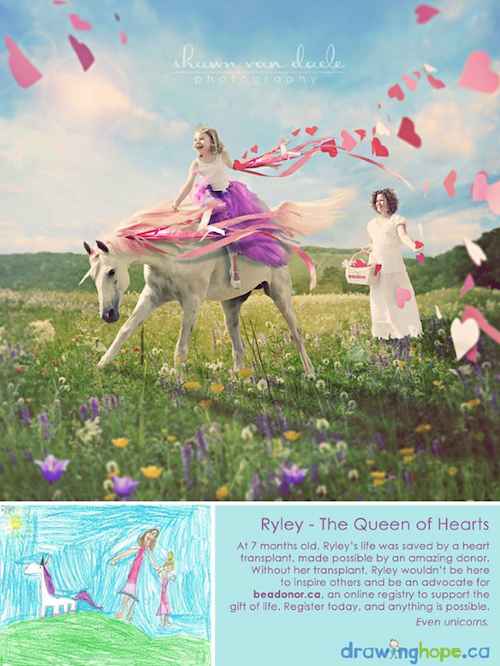 |